







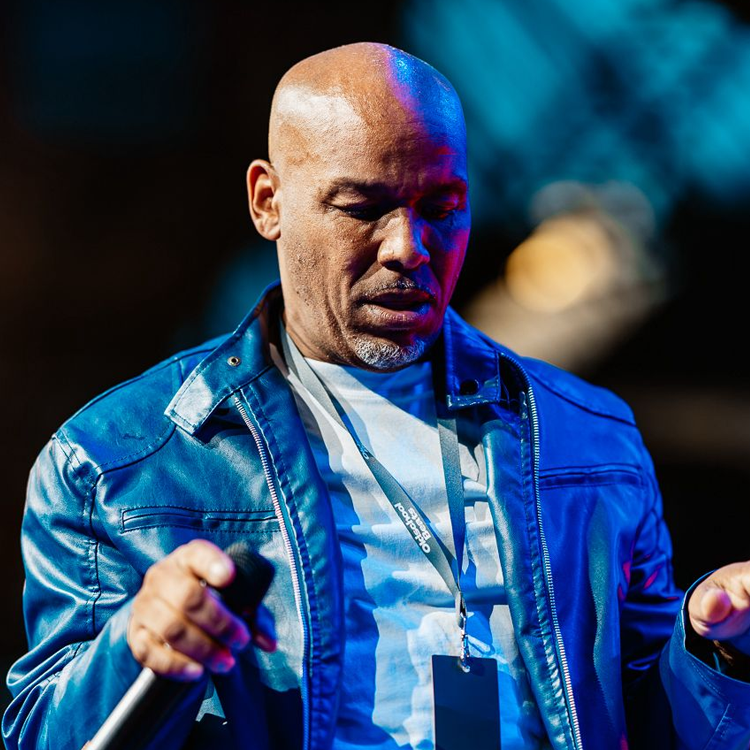


Some artists make records. Some make moments. And every once in a while, somebody helps create a song so undeniable that it outgrows the record, the era and even the people who made it. Numskull is one of those artists.
Born Garrick Demond Husbands and raised in Oakland, Numskull came up alongside childhood friend Yukmouth. Together, they became Luniz — two cats from the Town whose chemistry, humor, street perspective and unfiltered personalities turned friendship into a career and eventually into hip-hop history.
Then came “I Got 5 on It.” The song had that rare combination you can’t manufacture: a simple concept, a memorable hook, a beat that immediately felt different and two Oakland voices that sounded completely at home on it. What started in the Town traveled everywhere, becoming a generational anthem and, years later, finding another life when Jordan Peele’s “Us“ introduced its unmistakable sound to a whole new audience.
But every classic has a story behind the story — and this one belongs to Tone Capone, too.
Born Anthony Douglas Gilmour, Tone was one of the Bay Area’s distinctive sonic architects, bringing his own slow-rolling, soulful touch to records that helped soundtrack an era. His résumé stretched from Bay Area heavyweights including Mac Dre, E-40, 3xKrazy and Celly Cel to Houston legends Scarface, Devin the Dude and the Geto Boys. His production on Scarface’s “The Untouchable“ also gave us “Smile,” featuring one of Tupac Shakur’s final recorded verses.
Tone Capone passed away on September 12, 2026, at 59. That makes Numskull’s recollections especially poignant — not simply because Tone produced “I Got 5 on It,” but because Numskull was the one who carried the record into Tone’s orbit in the first place. The Luniz brought the idea. Tone helped give it the sound. Together, they made something that could only have come from that particular moment, that particular place and that particular chemistry.
And that’s only one chapter of the Numskull story.
There was “Operation Stackola“, the grind that came before the spotlight, the jokes and street realities that shaped Luniz, the highs and lows of success, the breakup, the solo chapters and, ultimately, the return to the partnership with Yukmouth. Through every turn, Numskull remained unmistakably himself.
That loyalty runs deep. So does the connection to the Town. For Numskull, Oakland wasn’t just where he was raised — it was where he learned about family, friendship, betrayal, failure, success, survival and knowing exactly who you are. That’s the part of the story that sometimes gets lost when everybody talks about the five dollars.
Because “I Got 5 on It” isn’t just a song about putting something in the pot. It’s about two Oakland cats putting everything they had into an idea — and watching that idea become something neither they, Tone Capone nor anybody else could have fully imagined.
Tone may no longer be here to witness the miles that record has traveled, but his fingerprints are forever embedded in the sound. And Numskull is still here to tell the story.
So this one is bigger than a classic record. It’s about friendship, loyalty, Oakland, Luniz, Tone Capone, the music and the people who turned a moment into a legacy.
The song is still playing. The Town is still talking. And Nummy Num still has something to say.
This one’s for Tone.
Before there was a platinum record, a worldwide hook or a Luniz logo, there was Garrick in Oakland. What did growing up in the Town give you — personally, musically and just as a human being — that you could never have learned anywhere else?
Oakland gave me everything — everything I know, everything I’ve been through. I’ve learned what sad is, I’ve learned what happy is, failure, success, betrayal, friendship and family. That knowledge came from growing up in Oakland.
I am who I am because of Oakland. It taught me how to be good to good people, and it taught me how to be ferocious with ferocious people. It also made me understand that family comes first.
You and Yukmouth didn’t come into the game trying to manufacture a “Luniz sound.” It was two Oakland cats being yourselves — funny, streetwise, unpredictable and comfortable enough to laugh at yourselves. When did you realize that chemistry between you two was actually the magic?
I knew it right away. From the moment we met, it was on. From that point, we ended up doing everything together — robbing, stealing, selling dope and surviving. So it was a given when we got into the music scene.
“I Got 5 on It” has been dissected a thousand times, but I’m more interested in the room before the record became history. What do you remember about the original idea, the energy around it and the moment you first thought, “Hold up…this might really be something”?
I’m the one that brought the record to Tone Capone. I used to walk around with that record under my arm, trying to find a producer who could make this beat for us.
Tone Capone is now gone, and that makes those memories hit differently. When you think about Tone — not just as the producer of “I Got 5 on It,” but as a person and a Bay Area creative — what’s something about him you wish people knew beyond the legendary records?
I only knew Tone Capone through the music, parties and performances. I didn’t know him in his personal life or what he did outside the music.
Tone flipped the Club Nouveau record into something completely different, adding the slowed-down feel, bells, scratches and that unmistakable Bay Area atmosphere. From your side of the microphone, what did his production bring out of Luniz that helped make the record feel like Oakland?
So Tone didn’t bring the idea to the Luniz — the Luniz brought the idea to him.
If you have a producer that’s from Oakland and you have the artist that’s from Oakland, no matter what sample you use, it’s gonna end up with an Oakland vibe.
But the difference between the Luniz being from Oakland and other artists from Oakland — and this is no disrespect to any of them — is that we made worldwide music from the beginning. People didn’t even think we were from Oakland. They thought we were from New York.
“I Got 5 on It” became an anthem because the concept was so simple — everybody putting something into the pot. Looking back, do you think that everyday Oakland reality is actually the secret to why the song connected with so many people around the world?
That song could relate to everybody, even if they didn’t smoke weed, because the concept was putting in on something — putting something in the pot to get something for everybody. That’s a worldwide thing.
But it became an anthem because of manufacturers. It was the right time, the right artist, the right producer, the right label and the right topic. Plus, a little luck didn’t hurt at all.
Then “Operation Stackola“ dropped and suddenly the guys from the Town weren’t just representing Oakland — they were representing the Bay on a national stage. What do you remember about that first realization that something born in your neighborhood had escaped the neighborhood?
We did “I Got 5 on It” two years before it came out. We kept that song hidden because we knew it would be the one. But the day I knew that we had something incredible was when we did the Houston Astrodome, I think it was. I asked the crowd to put the lighters in the air because we were about to perform “I Got 5 on It,” and what I saw was a sea of lighters.
That’s when I knew — the youngsters from the hood were on our way to conquering the world.
One thing I’ve always found interesting about Luniz is that y’all could talk street life without losing the humor. Where did that balance come from? Was making people laugh part of the survival mechanism, part of your personalities, or simply how you and Yuk naturally saw the world?
That was us every day, and that’s how we saw the world. If it was funny, we laughed and made jokes. If it was serious, we got down and dirty. If it was lovely, we gave love to it.
Speaking for myself, I couldn’t turn away from reality. I couldn’t be somebody that I wasn’t, and I couldn’t rap about shit that I wasn’t doing.
Life took you through some extremely different chapters, and eventually you and Yuk found your way back to Luniz with “High Timez“ and “No Pressure“. What had changed in you by the time you stepped back into that chemistry — and what felt exactly the same?
I never wanted to do solo albums. I’m the type of person that says, “We started together, we gonna end it together.”
I’m a very loyal person. So after the breakup, we came back together to do another album, and it was just like we never left.
Because, like I said, in the beginning, we always were the same when we were younger. So when we get together and start doing music, even though we will fight and argue, for some reason it brings out the best of both of us when it comes to music.
You’ve spoken about loving Oakland even while recognizing the changes and struggles happening around it. After everything you’ve seen — from the early days of Bay Area hip-hop to today — what do you think outsiders still misunderstand about the Town and the people who come from it?
People from Oakland — well, I’m gonna speak on back in the day — we never looked towards other places to find out what was cool. We made up the cool ourselves.
Many cities wanted to be like Oakland. Not to say that they didn’t have their own thing, but Oakland was a city that created the new — from the Black Panthers to the Luniz.
But I’m sad to see that we lost that. Seems like we wanna do the wrong shit now and be like everybody else.
Tone is no longer here to see what became of the record he helped create, but “I Got 5 on It” is still being played in stadiums, movies, cars and places none of y’all could have imagined in 1995. When the smoke clears and you look at the whole picture — Luniz, Oakland, Yuk, Tone, the music and the life in between — what do you want people to remember about the story behind the song?
That song came from a place of struggle, a place of friendship, a place of love and a place of wanting something bigger and better than what we had. That song gave it to us.
What I’m most proud of is it’s still played to this day all around the world. I’ve been touring all around the world for the last three years. I’m just happy that we were able to make a song that touched so many people.
And those people, which I don’t call fans because that’s short for fanatic, I call them Fam, which is short for family, because they helped make that song a classic. And nothing can take that away from them or us.