







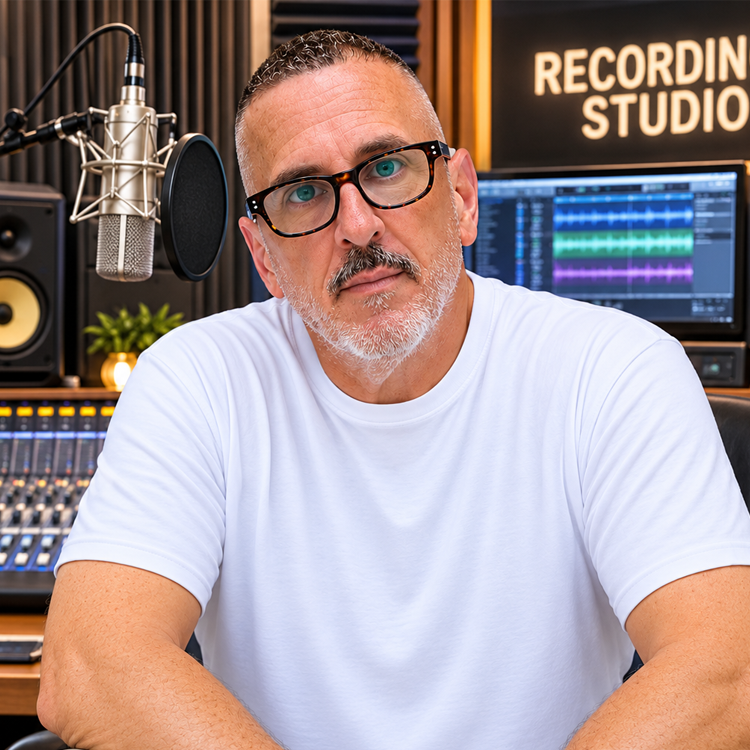

MC Serch‘s impact on Hip-Hop extends far beyond the records. As one-third of pioneering group 3rd Bass, alongside Pete Nice and DJ Richie Rich, he helped reshape the Golden Age with classics like “The Gas Face” and “Pop Goes the Weasel.” Following the group’s breakup, he released “Return of the Product” (1992), featuring “Back to the Grill” and an early appearance by Nas.
Behind the scenes, Serch executive produced Nas’s landmark “Illmatic” and “It Was Written”, O.C.’s “Word…Life”, and helped introduce underground collective Non Phixion to a wider audience. His career also took him into television, radio and podcasting, including VH1’s “The (White) Rapper Show” and “Miss Rap Supreme.”
In 2026, Serch returned to recording with “Millions of Zeros”, a six-track EP produced entirely by Apathy and featuring Ice Cube, Boldy James, OT The Real and Pete Nice. A full-length follow-up is in the works, though a 3rd Bass reunion is officially off the table.
In this conversation, Serch reflects on 3rd Bass, his solo career, his work shaping influential artists and his evolution as a cultural voice. From the microphone to the boardroom, from music to media, MC Serch’s story is one of creativity, influence and contribution — beyond the records and beyond the headlines.
When people bring up 3rd Bass, they usually go straight to the controversy or the optics. But musically, what do you feel still gets overlooked about what that group actually brought to Hip-Hop?
The depth of our sampling and the effort we put into our production. Whether it was the layered samples or complex alternative samples that created beats and music for Hip-Hop fans, the artists we worked with, or the producers we collaborated with to create classics, there are a great deal of things I think get overlooked.
There was wit, edge, technical skill and real intent in those records. Looking back now, how much of 3rd Bass was competition, and how much of it was cultural conviction?
It was 80% competition, for sure. Culture was always a part of what we did and why we did it. Being signed to Def Jam was a cultural stamp, and enough of a win!
The first time I heard Prime Minister Pete Nice, I knew I wanted to be better than him on every song we did. It became a mantra for me to sharpen my pen and craft lyrics that would let listeners know we were two separate MCs who formed a group, as opposed to a group formed out of friendship.
That was GYP (Get Yours Posse) for me, which consisted of friends I rhymed with and grew up with, including Zev Love X, who later became MF DOOM. Pete and I were competitors within the same group, like Shaq and Kobe or MJ and Scottie Pippen.
The chemistry between you, Pete Nice and DJ Richie Rich gave 3rd Bass its own identity in a crowded era. What did each of y’all bring to that formula that made it hit the way it did?
Daddy Rich was the best DJ in the world. He was part of The Supermen, a DJ crew started by DJ Clark Kent (RIP), alongside DJ Scratch and DJ Richie Rich. He was the greatest, and he brought those skills — scratching, production and turntable mastery.
Pete had an English degree. He graduated magna cum laude from Columbia with a degree in English. His knowledge of the language was unparalleled. The first line of “Words of Wizdom” says it all: “Hard as hard as Chinese Arithmetic/Avant Guarder, not a heretic.” The wordplay was crazy!
I was more of a storyteller, drawing from my life experiences in Far Rockaway. I was an MC who could rhyme off the top of my head and create stories.
After 3rd Bass ended, Return of the Product felt like you stepping out with something to prove — but also with a broader vision. What did going solo unlock for you creatively that the group format couldn’t?
I wouldn’t say it was something the group couldn’t. The great thing about working with Pete on those records was that we did whatever we wanted. We explored and pushed each other. That was the uniqueness of what we did. When I listen back now to those albums, as well as this new one we’re about to release, Icabod’s Cranium (since shelved third 3rd Bass LP), I hear how great our creativity was as a group.
For me, it was much more about exploring what I wanted and what the producers I worked with were looking to create.
When I left the group, I had just gotten married, signed O.C. and was at a turning point in my life. I was about to turn 25, and that was a big deal for me. In four years, I had gone from releasing my first album to creating music for myself and other artists. I was in a different space.
Working with producers Wolf and Epic was life-changing! Having access to amazing studios in L.A., being young and in love in the city, and having the freedom to move how I wanted was incredible. I was able to challenge myself and express what Wolf and Epic were looking to produce.
Wolf had the idea for “Hard But True.” He loved the concept of hard truths and wanted to present that idea from an MC and Hip-Hop perspective. It would have been completely different if we had worked together as a group.
“Back to the Grill” became one of those records that aged into folklore, especially with that early Nas appearance. Did you know at the time that you were capturing a moment bigger than the record itself?
Yes. From Red Hot Lover Tone to my deep friendship with Chubb Rock, my bond with O.C., and working with Anton Pushansky and, of course, T-Ray, it was one of those moments when you find yourself in awe.
However, when Nas came to Chung King, hung out, returned the next day and dropped his verse, I knew it was going to be special. I’m glad fans still enjoy the song.
Your solo work had humor, aggression, perspective and industry awareness all in one. Was that period liberating for you, or was it also a little lonely having to carry the whole narrative yourself?
It wasn’t lonely at all. I felt surrounded by greatness. DJ Riz, DJ Eclipse, Sabac Red, O.C. and the entire D.I.T.C., Nas, Jungle, L.E.S., Q-Tip, Preemo, Faith Newman, Stu Fine — the list goes on and on. Petey Mix, who allowed us to live in his studio in Long Beach.
It was freeing, and it was an amazing, simply beautiful time. I was free and building something even bigger than music.
You’ve always had one of the best ears in Hip-Hop — not just for bars, but for timing. How much of that instinct was already there in your artist days, and how much of it sharpened after you got deeper into the executive side?
I’ve figured it out: I am a “Cultural Meteorologist.”
I have this instinct to predict cultural influences early. This way, I’m able to throw out as many bottles as possible to capture lightning in a bottle. I’ve always had a knack for seeing things ahead of a cultural zeitgeist.
Plus, the come-up is the best part of the journey! From Nas to Boldy James and Neisha Nesche, from Sam Sever to Wayne616 — producers and creators. It has been an amazing life.
A lot of artists from your era either got boxed into nostalgia or disappeared from the conversation. You managed to stay relevant without forcing it. What’s been the key to evolving without losing your DNA?
Being humble and coachable. The truth is, I’m not part of the conversation. I’m no longer relevant. If I were, I’d have 100,000,000 followers and not 92,000.
Relevance is an ego-derived notion. I stay active. I always have motion, and that’s because I move in silence.
While I’m grateful that there are people like you who are interested in what’s popping with me, I’m also grateful that I can still provide for my family and make a living. I’m glad my music no longer carries the burden of my lifestyle. It’s a beautiful thing to be where I am and still enjoy doing what I do. How many can say the same?
You’ve gone from 3rd Bass to solo records to helping shape careers and moments behind the scenes. Which chapter of your journey do you think people still haven’t fully given you credit for?
Honestly, what I’m truly proud of is the work I did during the pandemic in 2020.
My partner Adam and I worked with a manufacturer in China to bring in 150,000,000 pieces of PPE across 27 states. Hazmat suits, N95 and KN95 masks, gloves and all the protective items our first responders needed while trying not to die as they helped people with COVID.
I remember a governor calling me and saying, “No matter what I did as MC Serch and 3rd Bass, he will always remember me for helping him open the largest hospital group in his state with PPE that I got him when he couldn’t get anything.”
That’s probably something most people don’t know about me. For me, it was the greatest moment of my life.
I was raised to believe that when there’s a need like that, you have to do whatever you can to be of service and help heal the world. I did my share.
Now fast-forward to “What The Stove Say.” What made linking with Boldy James, Cedric Louie and Handz Up feel like a natural move instead of just another feature play?
That’s family. Cedric is my brother, not just some feature. Boldy is my brother. We’ve been working together since 2011. I love these men as brothers.
Boldy had a line in one of his records where he talked about coming into the kitchen and the stove asking why his Balenciagas looked like Skechers. That’s where the idea came from.
I called Brocket Parsons, and we cooked up a bunch of beats to record. Cedric heard that beat and called it. I was in Detroit and had the verse. It was so dope that we did everything in the studio, all at the same time and in the same place. Me, Boldy, Cedric, Bo’s son and Nick Craven were there, and it was fire!
Ced hit me up and asked if we could use it for his album. It’s also going to be on my second solo album, which drops at the end of the year.
That record feels rooted in craftsmanship — bars, beat selection, atmosphere and intention. What did you want your presence on it to bring that maybe nobody else could’ve?
The similarities and differences in what our stoves say. Remembering that we both went through times when the heat was off or the electricity was off, and we’d sleep around the stove to stay warm.
We see the stove the same way. However, we both have very different experiences around those stoves and what we rely on them for.
From 3rd Bass to Return of the Product to now being part of the Milton Bradley chapter, what do you feel your legacy in Hip-Hop really comes down to when all the noise is stripped away?
Making timeless music. Being involved in timeless movements. Being involved with timeless cultural moments that have defined generations. I am deeply grateful.