







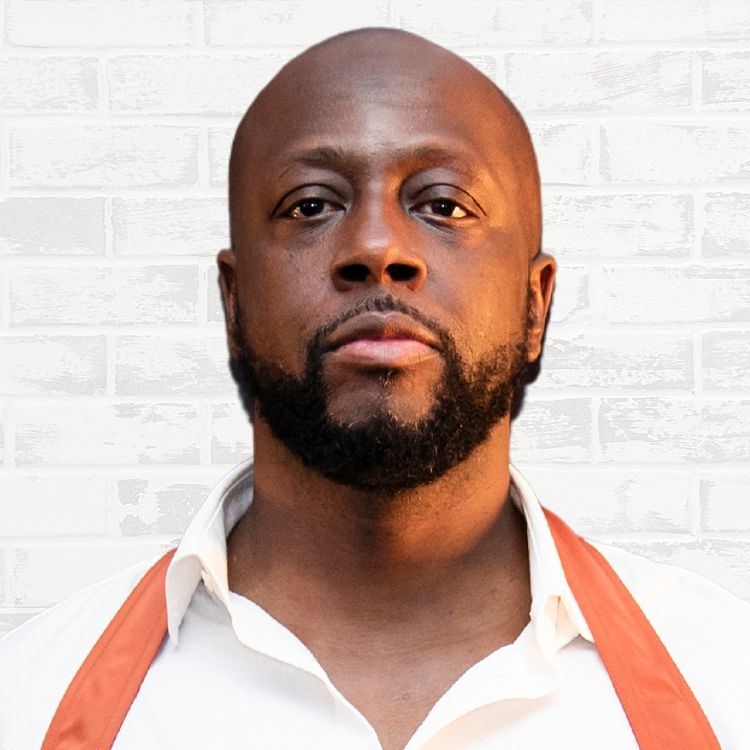


Some artists follow culture. Others shape it. For more than three decades, Wyclef Jean has done both, breaking musical boundaries and blending hip-hop, reggae, soul, jazz, and global influences into a sound uniquely his own.
As a member of the Fugees, alongside Lauryn Hill and Pras Michel, he helped redefine hip-hop with the landmark album “The Score”. His solo career, beginning with “The Carnival”, further established him as a global musical force, collaborating with artists including Mary J. Blige, Shakira, Carlos Santana, and Whitney Houston.
Thirty years later, Wyclef is celebrating the Fugees’ legacy through an anniversary tour and new creative projects, while his seven-album Quantum Leap explores the diverse influences behind his career. His curiosity also extends into artificial intelligence and music technology.
Now, that boundary-breaking spirit meets the legacy of Muhammad Ali through “Gladiator,” Wyclef’s original song for Prime Video’s biographical drama series “The Greatest”, executive produced by Michael B. Jordan and Shawn “Jay-Z” Carter. More than a musical tribute, the project honors Ali’s courage, cultural impact, and enduring inspiration.
In this Yo! Raps exclusive, Wyclef reflects on Ali, the Fugees, Quincy Jones, The Carnival, and Quantum Leap, exploring the meaning of greatness, creativity, and cultural influence.
More than three decades into his career, Wyclef continues to challenge expectations with one philosophy: never let the world put you in a box. Dream big, dream bigger, then dream the biggest.
Muhammad Ali was bigger than boxing. He represented confidence, conviction, cultural pride, and the right to define yourself, even when the world wanted to define you first. When you approach a song connected to a life like his, what part of that story speaks to you most, and how did that connection shape “Gladiator”?
The part of the connection that spoke to me the most is that, as young Fugees, we made a vow that the music was just the amplification for the movement and that we would be a movement. The first time we connected with Ali, we did a… It was for the Rumble in the Jungle soundtrack. So we came in, and that was a documentary. We all got a chance to connect with Ali. And one thing we’ve learned from Ali…
Even as young militants, right? If you go back, whether you’re looking at a song like “If I Was President” or the Fugees performing at the Free Tibet concert and different things, what makes the youth do that at that time? Someone like Ali, right? We look at Ali and say, “We want to be like him.” It’s okay now if we’re not running with the crowd. Yeah, because even the crowd is lost, and later on in life, they’re going to have to come to this sense of what’s right—the side that made sense.
So, for me, taking all of this inspiration, there was only one word to me: the word Gladiator, right? Because it’s like self-sacrifice for the arena. And this man, throughout his entire life, sacrificed himself to make it better for us as a people.
And so, “Gladiator” becomes the musical calling card for The Greatest, a series revisiting Ali’s life and legacy for a new generation. When you’re creating music for a story with that much history behind it, how do you honor the man without simply trying to recreate the legend everyone already knows?
For me, you know, I’ll be forever a student of Quincy Jones. And, you know, I came up as a jazz major, which a lot of people probably don’t know. I’m the one who scored the movie Life, which was a period piece with Martin Lawrence and Eddie Murphy. I did the theme song for Hotel Rwanda, right? So, in looking at how I’ve approached theme songs for movies, and also looking at how Quincy Jones approached theme songs as a mentor, I was inspired by the idea of how I could create sonics and sounds, even before the vocals came on, that you could feel were bigger than the arena.
Because this man is, like, bigger than seven heavens put together. So that was the energy we were trying to portray. And then finding a vocalist who, once he said the word “Gladiator,” you could feel it ringing through your soul.
And, as Ali understood the power of words, timing, personality, and knowing how to command a room long before the bell rang, as a lyricist, performer, and showman yourself, do you see a connection between the way he used his voice and the way music can turn an individual’s message into something the world carries forward?
Definitely. Again, I wouldn’t be able to do it if I hadn’t seen someone who did it before me in an elegant, suave, non-defiant way. So Ali was that dude who made those predictions. He was that dude who would rhyme one word with another. He was that dude who was curious about being around all walks of life, whether you were an astronaut, Bruce Lee, the greatest rock star, or even a Klansman. He was willing to sit down with you and give you the business.
And, your journey from Haiti to the United States helped shape an artistic identity that could move between cultures without being confined to one sound. How much of that immigrant experience, your Haitian roots, and the determination to make your own way found its way into the music you create today?
I think the way it finds its way into the music is through my experiences. Coming from Haiti at eight years old, growing up in Brooklyn, New York City, in Coney Island, and then moving to Jersey, I think the combination of the gospel music and church music they played in the house, along with the music my uncle played when I went to his house—all the Cuban and Haitian music, Tabou Combo, all the Calypso music—that was coming out of that side.
Everything coming out of Brazil, too. My uncle was playing all of this as a DJ. And then, in school, studying jazz, right? Being a jazz major at a very young age. I never looked at us as humans as people who could be put in a box. I felt like the word “box” was what they were trying to use to bamboozle us, right? Because when you look at a man like Ali, where he came from, his name rings bells throughout the entire universe. So, in order to do that, you have to perform at your highest level, not just in the ring but outside the ring.
And with your solo debut, Wyclef Jean Presents The Carnival, it opened another door, showing listeners a side of you that stretched beyond the Fugees while embracing an international palette of sounds. What were you determined to express on that album that you couldn’t fully explore within the group? And how did it shape the artist you became afterward?
Well, what’s on that album is what you see today. So today, it’s normal for my daughter to go from Jay-Z to Coldplay to Celia Cruz to 50 Cent to Bach. It’s very normal for her, right? Because she shapes her playlist how she wants, right?
But in an era when it was like, “Okay, radio is in control,” and if it doesn’t sound like this, it can’t be on the radio, I was like, “It’s a big world.” So, what does this sound like in Africa? What does this sound like in the Middle East? What does this sound like in parts of Europe and parts of Asia?
Getting a chance to travel, The Carnival, to me, was like a travel guide. I said, “I’m going to bring back a travel guide to Brooklyn and New Jersey for everybody who couldn’t make those trips and understand those languages.”
So, when my friends were like, “Yo, you know, what happened in London?” You feel me? Like, “Yo, what happened when you were in Africa? What happened when you went to New Zealand? You know what I’m saying? And what’s up with Haiti when you went to Haiti?”
So, The Carnival represents us, right? The whole idea behind The Carnival is to say that we, as humans, have more in common than we think, despite our differences. The gumbo. It’s the fusion. If I put disco and country together, they said, “This is not going to work,” right? It was just the first of its kind. It’s like a mushroom trip. You know what I’m saying? It was like the first of its kind.
But, at the end of the day, I was inspired by people like Basquiat, right? I knew that if I painted a picture, it would take the world time to understand it. But I think now The Carnival is more understood than it was when it first came out.
And just rewinding back to the Fugees and the cultural impact of The Score, that album brought together hip-hop, soul, reggae, social commentary, and musical ideas that didn’t always fit neatly into the industry’s categories. Looking back, what did that chapter teach you about trusting your instincts and letting the music speak in more than one language?
Well, the thing about the Fugees is you have to understand the rebel tone that you get from that. That’s just how we’ve always been, right?
Somebody was saying that the other day. I think it was Teddy Riley or somebody. He was like, “Yo, these kids would be walking in carrying their drum sets, carrying their guitars, carrying their basses,” in the middle of, like, “Oh, who are we opening up for? Wu-Tang Clan,” right?
So we literally were like, “We’re going to bring this to our culture.” Whether it’s something they have to learn or something they have to know, you get what I’m saying?
And then we wanted to kill that stereotype where they’re like, “Yo, if you’re from the hood, all you could be is a drug dealer,” right? So, no, my cousin could be a drug dealer, and I can be a lawyer. My brother could be a dentist. Another dude could be a doctor. And then my man could be in the suburbs, right? We go check him out and learn something from him, and he learns something from us. Then we bring it back down to the hood.
So that was just the idea of high-level thinkers, right? Philosophers, poets—a combination of what happens when the suburbs get together with the hood and collectively have this conversation.
I know you mentioned Quincy Jones a couple of times, both in this interview and the last one. He championed musical curiosity and the freedom to move across genres rather than living inside this so-called box. As you continue developing Quantum Leap, with its different musical chapters and influences, how are you applying that philosophy now? And what can listeners discover about you through this new body of work?
Through these seven albums, which I’ve been working on for seven years, what listeners can discover is that everything you’re listening to, you can trace back through the past 30 years and find out how I was a genre-bender before it was even a word.
So, when you hear my country album, I didn’t just wake up and say, “Let me do a country album.” You have to Google Wyclef Jean and Kenny Rogers, Wyclef Jean and Johnny Cash, Wyclef Jean and Big & Rich. You know what I mean? You’re going to be like, “Holy shit! This dude was doing this 20 years ago, and people weren’t paying attention. They thought he was crazy,” right?
So the whole seven-album project is all about discovery, right? It’s about what we talked about today: we can’t be put in a box. So I’m going to show you every genre I’ve been involved in over the past 30 years and why you shouldn’t be put in a box. And I’m going to perform it in its highest form of art. I’m going to get the best collective and put it together. You know what I’m saying?
So, even if you aren’t up on it now, by the time you get up on it, you’re going to be amazed, right? Remember, fine art isn’t just the art that you walk into a gallery and see, right? It’s about that discovery. Sometimes it takes longer, but once you get into it, you really get into it. And that’s what’s going to happen with these seven projects.
Bringing it back to Muhammad Ali, his greatness was measured in victories, but his lasting influence also came from the choices he made when the stakes were bigger than just a championship. As someone whose career has moved between music, culture, humanitarian work, and public life, how do you define greatness when the applause fades and the real decisions begin?
I think that… How do you define greatness again? You said?
…when the applause fades and the real decisions begin?
Yep. So, how do you define greatness when the applause fades and the real decisions begin? I think it goes back to family, real family. You know what I mean? Like I was saying, stability is when your daughter feels like she’s your best friend, right? They’re going to tell you the truth. Because your wife’s going to tell you the truth, too.
So, when everything is down and nobody’s with you, and everything goes silent, that’s when your true family comes around and lets you know it’s going to be okay. And I’ve had a few of those dark moments. And the most amazing thing was having real family come and tell me that.
Yeah. I love that. And to close this one off, as “Gladiator” introduces your music to the world of The Greatest, what do you hope listeners take away from the connection between the song and Ali’s story? And when people look back on your journey from Haiti and the Fugees to your solo work, what do you hope they understand about the purpose behind everything?
I mean, I always tell the kids, look, dream big, then dream bigger, then dream the biggest. Never lose your imagination. Work hard, and anything you want is possible.
Now, this “Gladiator” theme is going to outlive all of us. It’ll be here for centuries to come. When people hear this, I just want them to get the feeling that anything is possible.
This is the joy that you put on during the last three minutes on the treadmill, when you feel like you can’t go anymore. You’re running that marathon, and you can’t go anymore. Just click that button when you feel like the world is trying to get one up on you and you won’t let them defy you. You know what I mean? That inspirational music.